ROBOT LEARNING · REAL-WORLD SYSTEMS
Bowei Li 李博伟
M.S. Student, Department of Electrical and Computer Engineering
Carnegie Mellon University
About
I am a Master's student at the Department of Electrical and Computer Engineering, Carnegie Mellon University, advised by Prof. Changliu Liu in the Intelligent Control Lab. My research spans robot learning, scalable robot data generation, long-horizon manipulation, and agentic robot policies.
I received my Bachelor's degree in Telecommunication Engineering jointly from Xidian University and Heriot-Watt University. During my undergraduate studies, I worked at the Digital Governance Engineering Research Center led by Prof. Huailiang Liu on sentiment analysis, and was also remotely advised by Prof. Ran Zhang from UNC Charlotte on reinforcement learning for UAV communications.
Email: boweili [at] andrew [dot] cmu [dot] edu
Research
Publications & Preprints
* denotes equal contribution. Author names in bold indicate me.
Under review · ICRA
ARSTAG: An Agentic Real2Sim2Real System for Task-Specific Robot Data Generation
arXiv preprint, 2026 · Submitted to ICRA
abstract · bibtex · arXiv · project page · video
@misc{li2026arstag,
  title         = {ARSTAG: An Agentic Real2Sim2Real System for Task-Specific Robot Data Generation},
  author        = {Li, Bowei and Zhang, Yuner and Liu, Changliu},
  year          = {2026},
  eprint        = {2609.24563},
  archivePrefix = {arXiv},
  primaryClass  = {cs.RO},
  url           = {https://arxiv.org/abs/2609.24563}
}
Under review · RA-L
arXiv preprint, 2026 · Submitted to IEEE Robotics and Automation Letters (RA-L)
abstract · bibtex · arXiv · project page
@article{yu2026brickcraft,
  title   = {BrickCraft: Visuomotor Skill Composition with Situated Manual Guidance for Long-Horizon Interlocking Brick Assembly},
  author  = {Yu, Jichuan and Li, Bowei and Tang, Zhenran and Lu, Guanxing and Hu, Chuxiong and Liu, Ruixuan and Liu, Changliu},
  journal = {arXiv preprint arXiv:2605.07605},
  year    = {2026}
}
Under review · ICRA
arXiv preprint, 2026 · Submitted to ICRA
summary · bibtex · arXiv · project page
@misc{yu2026maniskillformer,
  title         = {ManiSkillFormer: Demonstration-Free Compositional Manipulation via Geometric Contracts and Agentic Skill Graph},
  author        = {Yu, Peiqi and Dabhi, Mosam and Li, Shangtao and Li, Bowei and Jeni, Laszlo and Liu, Changliu},
  year          = {2026},
  eprint        = {2609.16331},
  archivePrefix = {arXiv},
  primaryClass  = {cs.RO},
  url           = {https://arxiv.org/abs/2609.16331}
}
IROS 2026
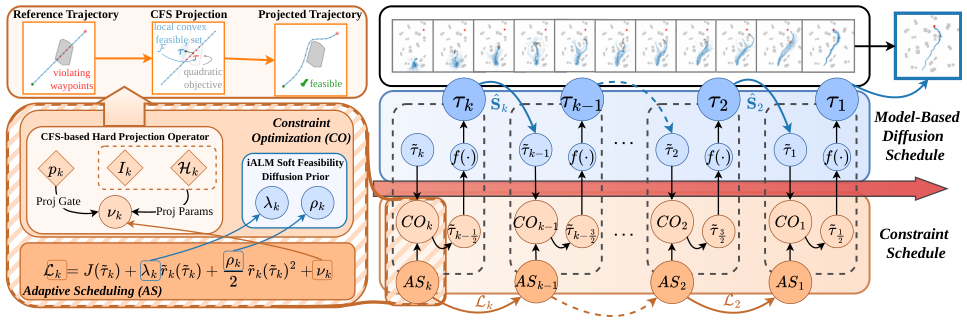
Motion Planning with Model-Based Diffusion via Constraint Optimization and Adaptive Scheduling
IEEE/RSJ International Conference on Intelligent Robots and Systems (IROS), 2026
@inproceedings{he2026mdcoas,
  title     = {Motion Planning with Model-Based Diffusion via Constraint Optimization and Adaptive Scheduling},
  author    = {He, Zhilin and Li, Bowei and Dou, Jianlin and Zhang, Yuner and Liu, Changliu},
  booktitle = {IEEE/RSJ International Conference on Intelligent Robots and Systems (IROS)},
  year      = {2026},
  eprint    = {2607.14455},
  url       = {https://arxiv.org/abs/2607.14455}
}
Under review · ACC
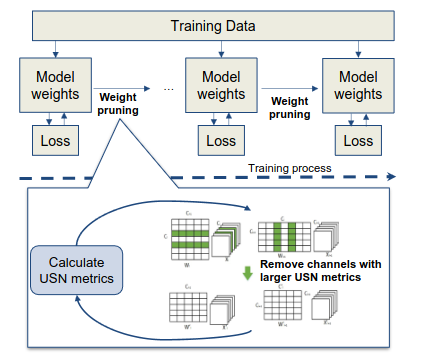
Enhancing Certifiable Semantic Robustness via Robust Pruning of Deep Neural Networks
arXiv preprint, 2025 · Submitted to the American Control Conference (ACC)
@article{hu2025enhancing,
  title   = {Enhancing Certifiable Semantic Robustness via Robust Pruning of Deep Neural Networks},
  author  = {Hu, Hanjiang and Li, Bowei and Wang, Ziwei and Wei, Tianhao and Hutchison, Casidhe and Sample, Eric and Liu, Changliu},
  journal = {arXiv preprint arXiv:2510.00083},
  year    = {2025}
}
WBCD 1st Prize · ICRA 2025RSS 2025 Workshop
NeSyPack: A Neuro-Symbolic Framework for Bimanual Logistics Packing
RSS 2025 Workshop on Benchmarking Robot Manipulation · First Prize, WBCD Competition @ ICRA 2025
abstract · bibtex · arXiv · video · competition
@article{li2025nesypack,
  title   = {NeSyPack: A Neuro-Symbolic Framework for Bimanual Logistics Packing},
  author  = {Li, Bowei and Yu, Peiqi and Tang, Zhenran and Zhou, Han and Sun, Yifan and Liu, Ruixuan and Liu, Changliu},
  journal = {arXiv preprint arXiv:2506.06567},
  year    = {2025}
}
IFAC 2025
SPARK: Safe Protective and Assistive Robot Kit
IFAC Symposium on Robotics, 2025
abstract · bibtex · arXiv · code · project page
@inproceedings{sun2025spark,
  title     = {SPARK: Safe Protective and Assistive Robot Kit},
  author    = {Sun, Yifan and Chen, Rui and Yun, Kai S. and Fang, Yikuan and Jung, Sebin and Li, Feihan and Li, Bowei and Zhao, Weiye and Liu, Changliu},
  booktitle = {IFAC Symposium on Robotics},
  year      = {2025}
}
IEEE TCCN
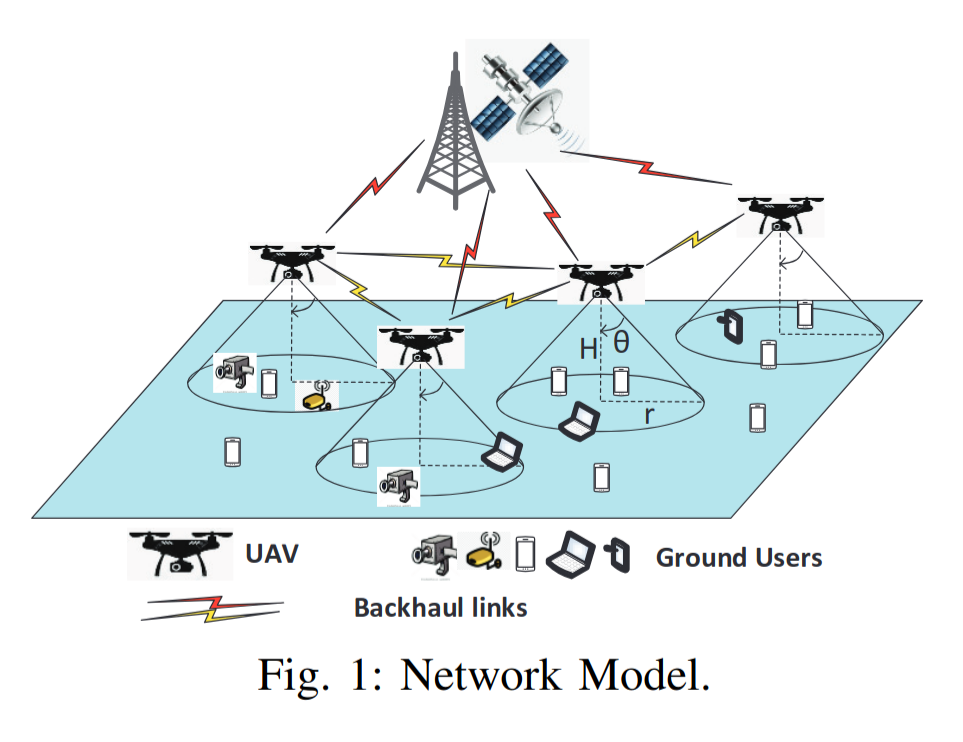
IEEE Transactions on Cognitive Communications and Networking, 12(1):175–188, 2026
@article{li2025when,
  title   = {When Learning Meets Dynamics: Distributed User Connectivity Maximization in AAV-Based Communication Networks},
  author  = {Li, Bowei and Tripathi, Saugat and Hosain, AKM Salman and Zhang, Ran and Wang, Miao and Xie, Jiang},
  journal = {IEEE Transactions on Cognitive Communications and Networking},
  volume  = {12},
  number  = {1},
  pages   = {175--188},
  year    = {2026}
}
IEEE ComMag
IEEE Communications Magazine, 64(1):72–78, 2026
@article{zhang2025learning,
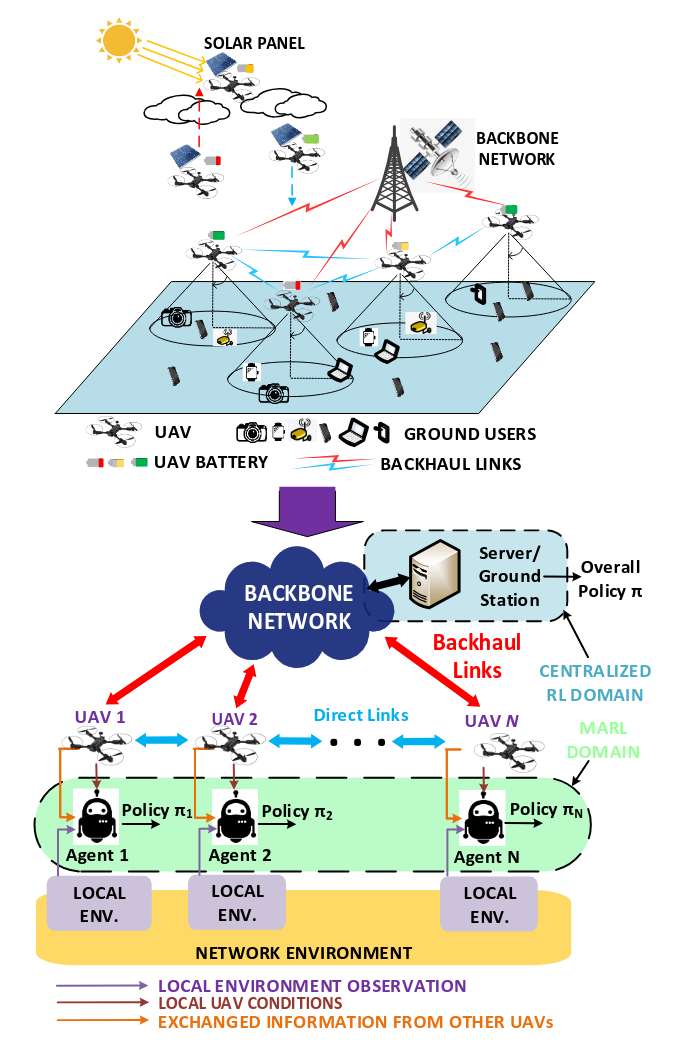
  title   = {Learning with Dynamics: Autonomous Regulation of UAV-Based Communication Networks with Dynamic UAV Crew},
  author  = {Zhang, Ran and Li, Bowei and Zhang, Liyuan and Xie, Jiang and Wang, Miao},
  journal = {IEEE Communications Magazine},
  volume  = {64},
  number  = {1},
  pages   = {72--78},
  year    = {2026}
}
ICC 2025
IEEE International Conference on Communications (ICC), pp. 530–535, 2025
@inproceedings{li2025maximizing,
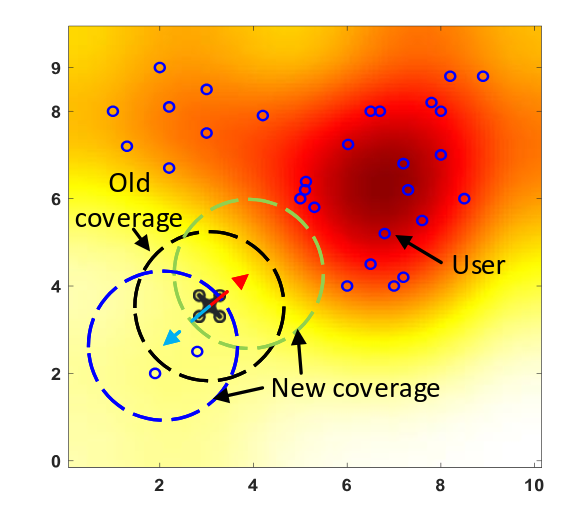
  title     = {Maximizing User Connectivity in AI-Enabled Multi-UAV Networks: A Distributed Strategy Generalized to Arbitrary User Distributions},
  author    = {Li, Bowei and Xu, Yang and Zhang, Ran and Xie, Jiang and Wang, Miao},
  booktitle = {IEEE International Conference on Communications (ICC)},
  pages     = {530--535},
  year      = {2025}
}
Project
PerSEVE
Perception by Segmentation, Extensible Visual Ecosystem
ARM Institute AIDF · Lockheed Martin ATL · Carnegie Mellon University · GE Aerospace · Sep 2025 – Jul 2026
PerSEVE builds manufacturing-specific data and foundation perception models for industrial parts. The project curated high-quality CAD models, generated large-scale labeled synthetic scenes in NVIDIA Isaac Sim, fine-tuned SAM 2.1 for manufacturing segmentation (SAM4MFG), and used geometry-driven hard-example mining to target the model's own failure cases.
My contributions. Led an image-based Real2Sim pipeline for object reconstruction, editable scene graphs, and relation-constrained Isaac Sim synthesis; developed physics-based synthetic-data generation with domain randomization and dense annotations.
Photo → segmentation → scene graph → Isaac Sim scene · 2× speed · 1:00
Generated simulation scenes paired with real-robot execution · 1:14 · see ARSTAG
Competition
WBCD Challenge @ ICRA 2025 · First Prize
What Bimanual Teleoperation and Learning from Demonstration Can Do
ICRA 2025 · Atlanta · Logistics packing track · Team from Carnegie Mellon University
Our CMU team won first place in the bimanual logistics-packing challenge at ICRA 2025, using a neuro-symbolic framework that decomposes packing into reusable skills with failure recovery. The system was later published as NeSyPack at the RSS 2025 Workshop on Benchmarking Robot Manipulation.
My contributions. Developed the neuro-symbolic bimanual task-execution pipeline combining skill graphs, object grounding, 6D pose estimation, and failure recovery; deployed on Unitree G1 and Galaxea R1 Lite.
Dual-arm logistics packing at ICRA 2025 · 0:30
NeSyPack walkthrough · 2:09
Featured by Galaxea Dynamics
Project
ETC · Future Football
Human–Robot Interaction for Future Sports
Carnegie Mellon University · Entertainment Technology Center (ETC)
A collaboration exploring how people and humanoid robots can play football together, through interactive prototypes and real-robot demonstrations on Unitree G1.
My contributions. Trained and deployed reinforcement-learning control policies on Unitree G1, and built ROS/Python interfaces connecting the robot stack to a Unity front end for interactive control and hardware prototyping.
Human–robot interaction showcase · 0:53
Unitree G1 lab demonstration · 0:18
Featured on LinkedIn
- Carnegie Mellon University — Powering the Future of Sport: A Draft Week Showcase.
Watch on LinkedIn · Excerpt from 0:37–0:40 in the full video - Derek Ham, ETC Director — Exploring human–robot football and the future of entertainment.
Watch on LinkedIn
Project
MASCEI · Automated PPE Production
Rapid-response robotic manufacturing in shipping containers
ARM Institute · NIST-funded · Oct 2024 – Sep 2025
An ARM Institute project with AFFOA, Siemens, Yaskawa, Carnegie Mellon University and industry partners, building automated face-mask production lines housed in shipping containers. The lines combine robotic sewing, automated visual inspection, picking and sorting, and end-of-line packing and palletizing, so they can go from set-up to production within days rather than months.
My contributions. Integrated hand–eye, tool, and environment calibration across four industrial robot cells, supporting a unified manufacturing calibration workflow.