Cone grasping2.07×Brick grasping2.07×Teapot handle1.19×Screw shaft2.07×Nut to plate3.12×Bowl stacking3.12×
Selected real-robot executions. Playback speeds are shown for each clip.
The idea
Make the data, then learn the task.
Simulation can supply robot training data at scale. Preparing the scene, designing expert behavior, and configuring collection still require substantial work for each new task.
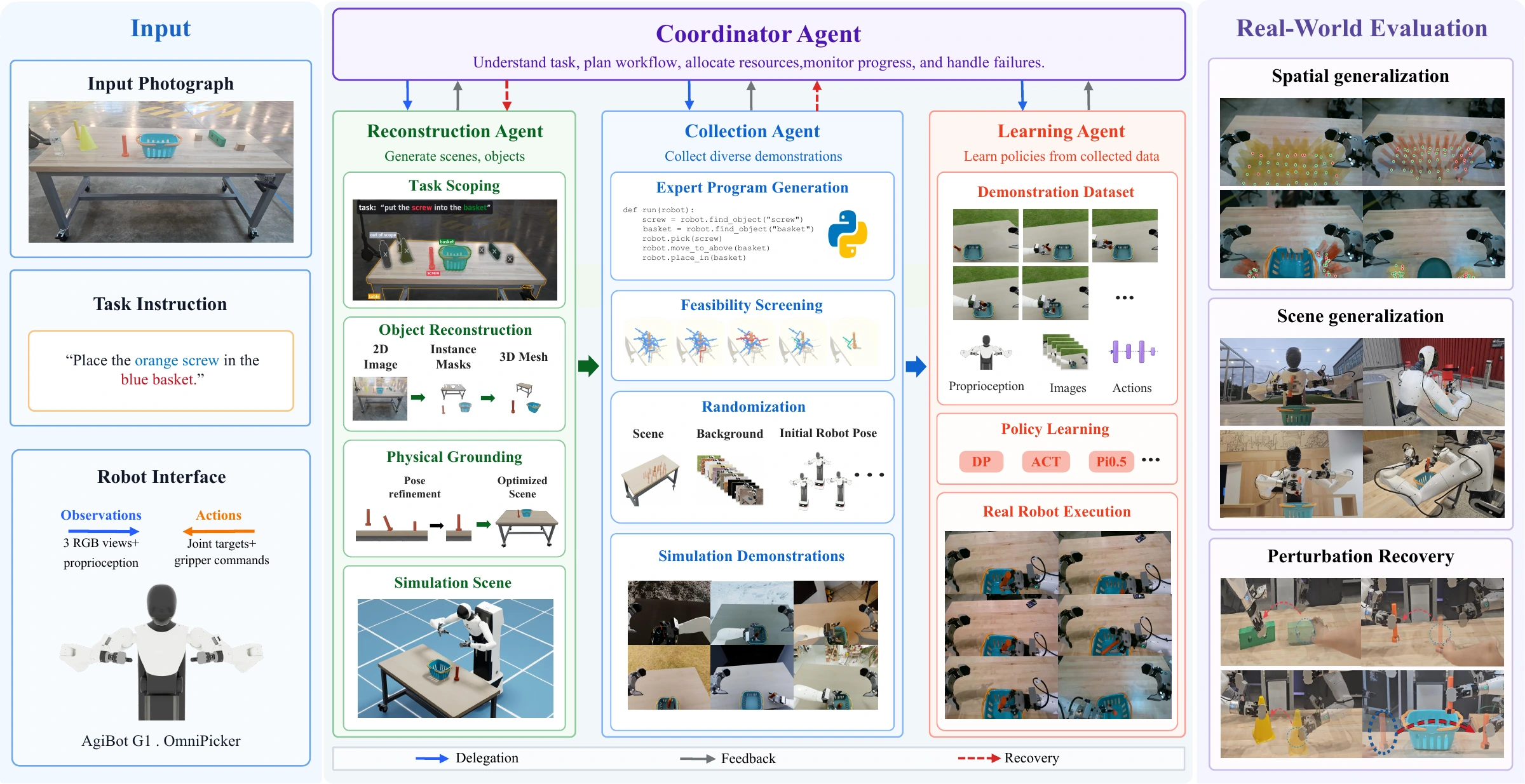
ARSTAG brings these stages into a coordinated agent workflow. Given a single RGB image and a natural-language instruction, specialized agents reconstruct the relevant scene, generate robot-feasible demonstrations, and train a visuomotor policy for real-world deployment.
7
real-world manipulation tasks
3
visuomotor policy architectures
1,000
simulation demonstrations per task
74.6%
Average real-world success across seven tasks with π0.5
Method
A coordinated path from image to policy.
A coordinator delegates work and uses tool feedback to guide revisions across stages.
ARSTAG reconstructs a task-scoped scene, generates demonstrations, and learns policies for real-robot execution. Click the figure to enlarge.
01 / Reconstruction
Reconstruct what the task needs.
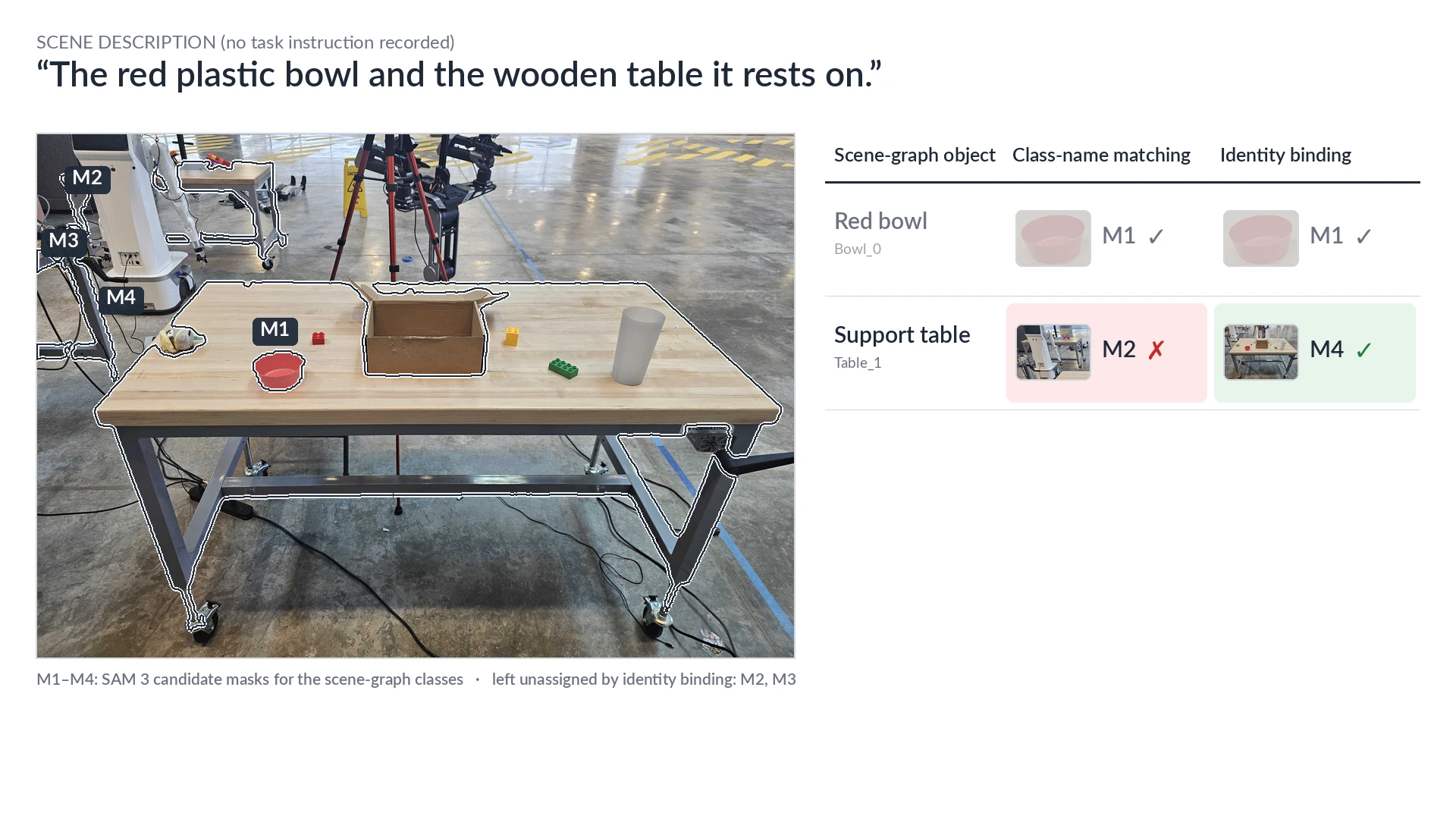
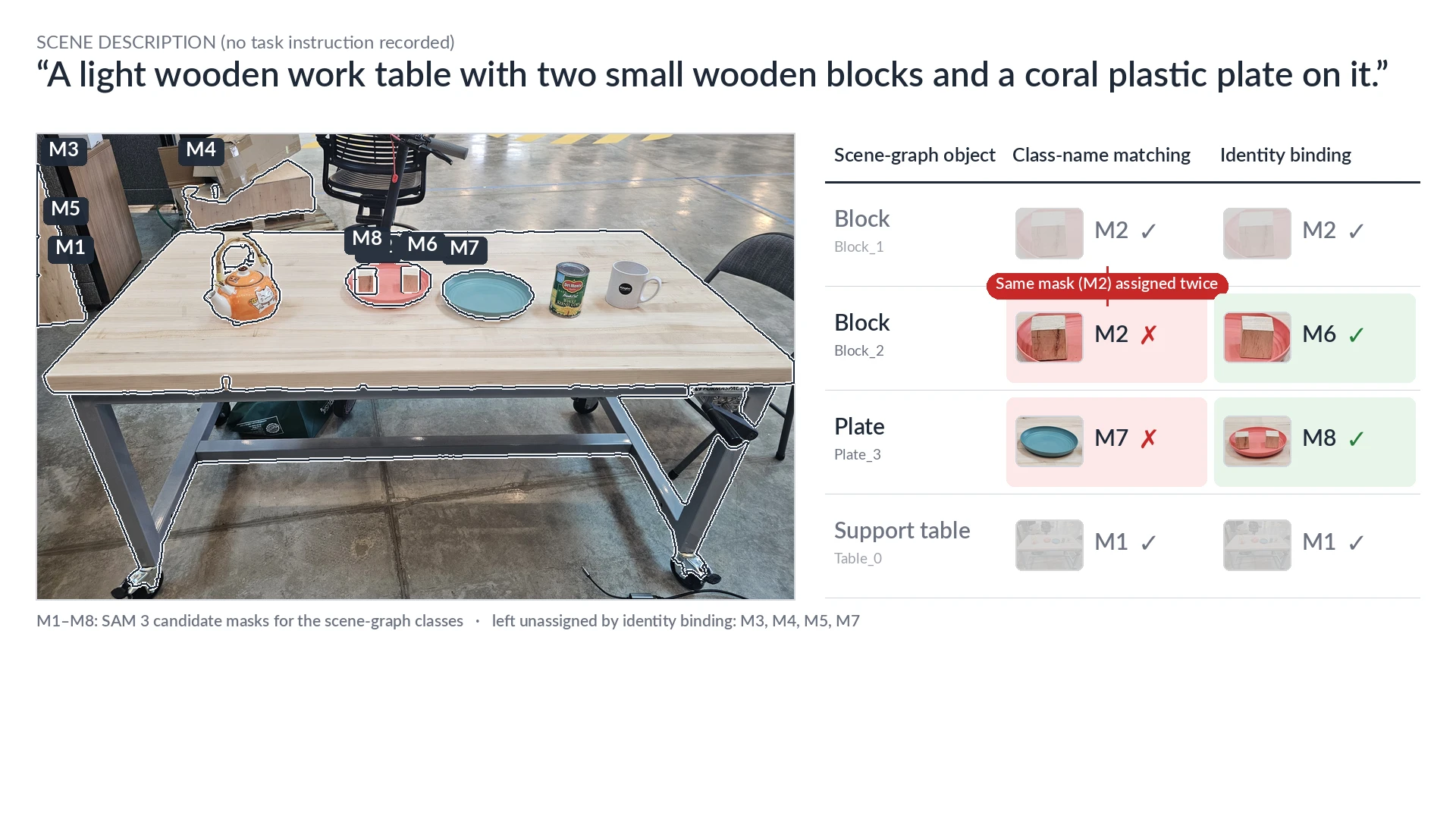
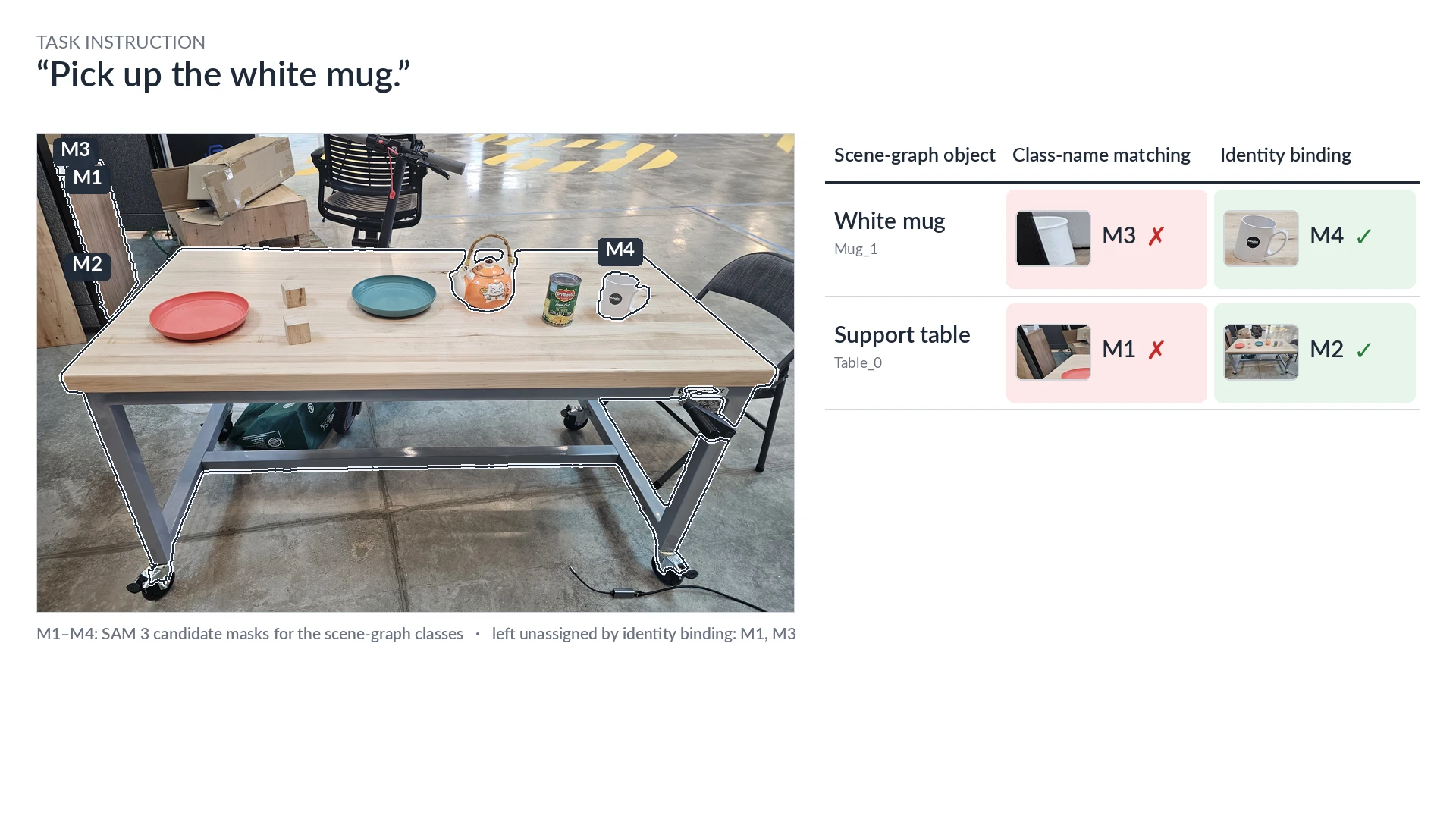
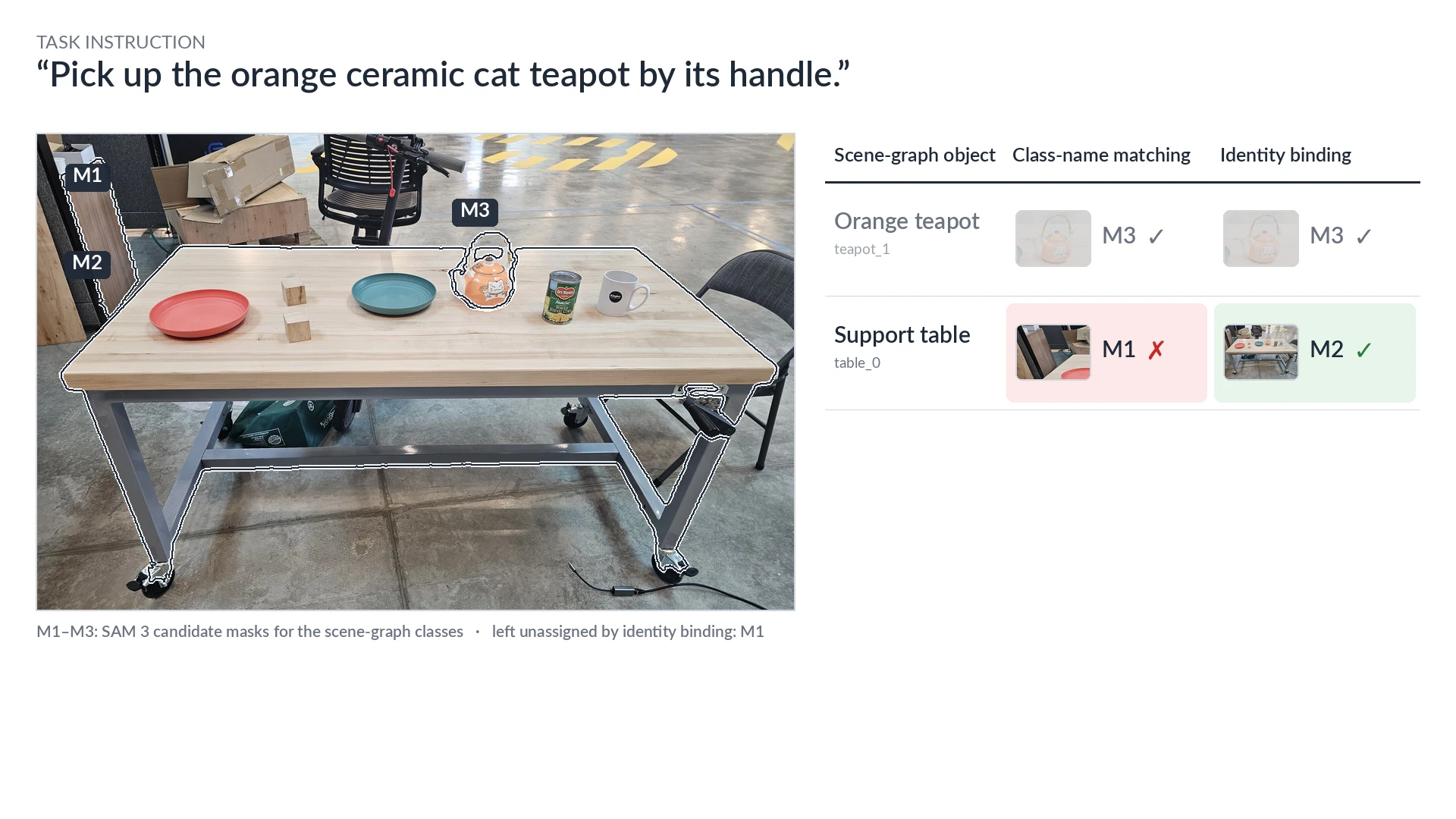
Vision-language reasoning selects objects and their supports in a scene graph. Caption-guided segmentation and identity binding link graph objects to image masks. Object reconstruction and support repair produce a usable simulation scene.
02 / Collection
A training-free simulation expert.
The collection agent generates an expert that uses ground-truth simulation states and state-based skills. Feasibility screening and task-consistent randomization produce demonstrations, including recovery from disturbed states.
03 / Learning
Learn from simulated demonstrations.
The learning agent configures policy training and closed-loop simulation evaluation. The resulting visuomotor policies use visual observations and proprioception for real-robot execution.
Demonstration library
Across scenes, objects, and disturbances.
Browse more simulation and real-robot recordings, with paired comparisons of the reconstruction and data-generation stages.
Randomized simulation demonstrations
The same task is executed across sampled object placements, robot configurations, and visual backgrounds. All 24 successful demonstrations play automatically in four consecutive groups of six. Each group finishes before the next begins.
Sampled scene 1
Screw-to-basket placement · 1× playback
Sampled scene 2
Screw-to-basket placement · 1× playback
Sampled scene 3
Screw-to-basket placement · 1× playback
Sampled scene 4
Screw-to-basket placement · 1× playback
Sampled scene 5
Screw-to-basket placement · 1× playback
Sampled scene 6
Screw-to-basket placement · 1× playback
Sampled scene 7
Screw-to-basket placement · 1× playback
Sampled scene 8
Screw-to-basket placement · 1× playback
Sampled scene 9
Screw-to-basket placement · 1× playback
Sampled scene 10
Screw-to-basket placement · 1× playback
Sampled scene 11
Screw-to-basket placement · 1× playback
Sampled scene 12
Screw-to-basket placement · 1× playback
Sampled scene 13
Screw-to-basket placement · 1× playback
Sampled scene 14
Screw-to-basket placement · 1× playback
Sampled scene 15
Screw-to-basket placement · 1× playback
Sampled scene 16
Screw-to-basket placement · 1× playback
Sampled scene 17
Screw-to-basket placement · 1× playback
Sampled scene 18
Screw-to-basket placement · 1× playback
Sampled scene 19
Screw-to-basket placement · 1× playback
Sampled scene 20
Screw-to-basket placement · 1× playback
Sampled scene 21
Screw-to-basket placement · 1× playback
Sampled scene 22
Screw-to-basket placement · 1× playback
Sampled scene 23
Screw-to-basket placement · 1× playback
Sampled scene 24
Screw-to-basket placement · 1× playback
Group 1 of 4 · Scenes 1–6
Recovery on the real robot
We also test perturbations during real-world execution. The learned policy uses updated visual observations to adjust its motion and recover.
Cone grasping
2.28× playback · operator-induced perturbation
Brick grasping
4.53× playback · operator-induced perturbation
Screw grasping
2.28× playback · operator-induced perturbation
Screw-to-basket placement
4.53× playback · operator-induced perturbation
Generating recovery demonstrations
During collection, we perturb the robot trajectory or induce a mis-grasp. Only the expert continuation from the disturbed state enters the training dataset.
Trajectory perturbation
The arm is displaced by 14 cm. The expert continues from the disturbed state. 2.1× playback.
Mis-grasp and target displacement
After an empty grasp, the object is relocated by 38 cm. The expert re-grasps it. 3.3× playback.
Identity binding across ambiguous scenes
Appearance and scene context link each selected scene-graph object to the intended mask and supporting surface. Each comparison includes its scene description or instruction.
Bowl and supporting table Click to enlarge ↗Repeated blocks and a plate Click to enlarge ↗Mug with background distractors Click to enlarge ↗Teapot and supporting table Click to enlarge ↗
Support repair before simulation settling
Each side-by-side pair shows the same scene without repair on the left and with repair on the right. Repair aligns object-support contacts before simulation.
Purple blocks
Left: without repair · Right: with repair · 0.44× slow motion
Bottle
Left: without repair · Right: with repair · 0.44× slow motion
Blocks and plate
Left: without repair · Right: with repair · 0.09× slow motion
Pear and basket
Left: without repair · Right: with repair · 0.09× slow motion
Two cones
Left: without repair · Right: with repair · 0.09× slow motion
Screw and basket
Left: without repair · Right: with repair · 0.30× slow motion
Real-world evaluation
Simulation data. Real-robot execution.
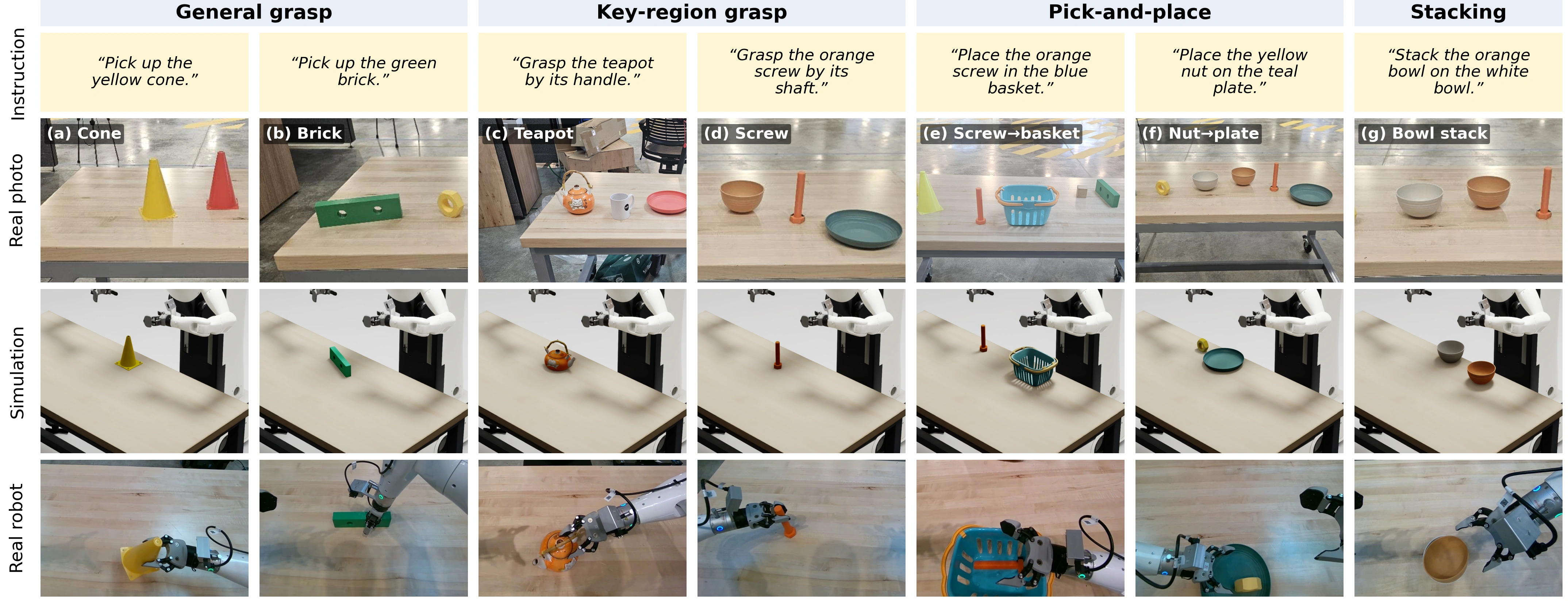
Seven tasks cover general grasping, key-region grasping, placement, and stacking. All three policy architectures use the same generated demonstrations for each task.
Seven tasks, from task instruction and real photograph to simulation and real-robot execution. View full resolution ↗
Real-robot closed-loop success rate (%)
Task
ACT
Diffusion Policy
π0.5
Cone grasping
55.0
77.5
65.0
Brick grasping
25.0
57.5
92.5
Teapot grasping
40.0
67.5
72.5
Screw grasping
62.5
72.5
90.0
Screw to basket
42.5
62.5
60.0
Nut to plate
35.0
62.5
67.5
Bowl stacking
45.0
67.5
75.0
Average across seven tasks
43.6
66.8
74.6
40 real-robot trials per task and policy. Bold values mark the highest success rate in each row.
Randomization ablation
Robustness beyond the collection conditions.
Leave-one-out ablations evaluate screw grasping under out-of-distribution conditions. Each cell reports success over 40 held-out simulation episodes.
OOD success rates with and without each randomization family
Tested family
Full recipe
Without family
Execution
75.0%
40.0%
Geometry
62.5%
40.0%
Background
70.0%
0.0%
Demonstration scale
More generated data improves policy success.
With 100,000 training steps held fixed, Diffusion Policy improves as the screw-grasping dataset grows. Each policy is evaluated over 40 held-out simulation episodes.
Success by number of generated demonstrations
Demonstrations
Success
50
0.0%
100
7.5%
200
27.5%
500
52.5%
1,000
62.5%
Qualitative randomization comparisons
Selected out-of-distribution screw-grasping trials. The top recording uses the full randomization recipe; the bottom removes the named family.
Execution randomization
Forced mis-grasp followed by target relocation. Same initial layout.
Geometry randomization
An out-of-distribution table and torso configuration. Same initial layout.
Background randomization
An unseen HDRI environment. Same initial layout and background.
The background video is a qualitative comparison: the full model uses a 200,000-step checkpoint and the ablated model a 100,000-step checkpoint. It does not isolate randomization under a matched training budget.
Agent execution and feedback-guided recovery
The full source animations show pipeline milestones and how tool feedback leads to scene revisions.
Agent execution profile
Agent activity, elapsed time, and token use through the workflow. The animation includes accelerated time and labeled milestones.
Fixed pipeline versus agent
The same task, tools, and collection/training budget. Tool feedback prompts the agent to revise the scene when the fixed pipeline stalls.